
Where Time Rests: The Journey of “Canto da Planície”
Where Time Rests: The Journey of “Canto da Planície”
Glender on how ‘Canto da Planície’ was born from a sense of recognition between the granite mountains of Trás-os-Montes and the endless Alentejo plain, why folktronica gave the tradition a modern pulse, and how the film turned memory into image.
“Canto da Planície” was born from recognition, not appropriation: a man from the North saw the same dignity, silence and connection to the land in the Alentejo plain. – Folktronica was used to give the tradition a new pulse, not to cover it: the beat is proof that tradition can stay authentic without staying frozen. – The lyrics pair the cork oak with sweat deliberately, so the landscape and the people who sustain it are never separated. – The film uses AI as a cinematic tool, not to erase reality, and its village square turns private sorrow into shared story. – In the North strength rises like stone; in the South it stretches toward the horizon. This song is the bridge between the two.
I was born in Trás-os-Montes, in the north of Portugal, a land of granite, steep paths, cold winters, and people shaped by endurance. My musical identity has always been connected to that landscape. The stone, the wind, the distance, and the memories of those who worked the land before us have followed me throughout my journey.
But roots do not prevent us from recognizing ourselves in another place.
Sometimes, we travel far from the landscape that formed us and unexpectedly find the same truth waiting there in a different shape.
That is what happened to me in the Alentejo.
“Canto da Planície” was born from that recognition. It is not an attempt to become someone else or to claim a tradition that is not mine. It is the story of a man from the North who looked across the vast Alentejo plain and recognized the same dignity, silence, strength, and connection to the earth that he had always known.
The mountains disappeared, but the soul remained.
From Granite Mountains to an Endless Plain
Trás-os-Montes and the Alentejo appear to be opposites.
In the North, the landscape rises around you. Mountains, valleys, narrow roads, and walls of stone shape the horizon. The land can feel protective, but also severe. Every journey seems to demand effort.
In the Alentejo, the land opens.
The horizon becomes almost infinite. The sky feels larger. The sun falls without mercy over the fields, and time appears to move differently. There is nowhere to hide from the heat, the silence, or your own thoughts.
Yet beneath these differences, I felt something deeply familiar.
I recognized the hands marked by work. I recognized the patience of those who live according to the seasons. I recognized the quiet pride of communities that do not need to speak loudly to prove their strength.
The geography changes, but the truth of the land does not.
From Bragança to Évora, the sweat of those who work the soil carries the same weight. The faces may belong to different regions, but they tell a shared Portuguese story: resilience, sacrifice, belonging, and an unbreakable relationship with the earth.
That emotional bridge between North and South became the foundation of “Canto da Planície.”
The Sound: Giving the Plain a Pulse
The Alentejo is often associated with stillness, but stillness is not emptiness.
There is rhythm everywhere.
There is rhythm in the slow movement of the fields beneath the wind. There is rhythm in the repetition of work, in footsteps over dry soil, in the voices that rise together in the village square, and in the long hours of heat when the entire landscape appears to hold its breath.
I wanted the production to respect that sense of space.
The music could not feel rushed. It needed room to breathe. The percussion had to carry the weight of the earth while the melodic elements created the feeling of an open horizon.
This is where folktronica became essential to the concept.
I used electronic production not to cover the traditional soul of the song, but to give it a new pulse. The beat represents continuation. It is the proof that tradition does not need to remain frozen in the past in order to remain authentic.
A traditional feeling can enter a modern sound system.
An ancestral voice can live inside an electronic rhythm.
A story from the land can still move a dance floor.
“Canto da Planície” continues the journey I began with “Canto de Xisto.” If that song carried the cold strength of stone, this one carries the heat, space, and sacred calm of the South.
Different landscapes. The same search for memory.
The Lyrics: A Land of Sun and Silence
The opening lines define the emotional world of the song:
“Ó terra que queima De sol e de calma Onde o tempo descansa E me toca na alma”
In English:
“Oh land that burns With sun and calm Where time comes to rest And touches my soul”
The idea that time rests became one of the most important images in the entire song.
In modern life, everything moves quickly. We are constantly being pushed toward the next task, the next message, the next destination. But in the plain, time feels physical. You can almost see it stretching across the horizon.
The landscape forces you to slow down.
It asks you to listen.
Not only to the birds, the wind, or the distant voices, but to everything inside yourself that has been hidden beneath the noise.
The chorus continues:
“Planície sem fim De sobreiro e suor Alentejo sagrado Meu canto maior”
The cork oak and the sweat are placed together deliberately.
One represents the landscape. The other represents the people who sustain it.
Beauty in this song is never separated from work. The golden fields are beautiful because generations of hands have cared for them. The villages carry peace because people fought to preserve their way of life. The landscape is sacred not because it is untouched, but because it holds the marks of human effort.
The Weathered Skin, the Hand That Never Fails
One of the lines that most strongly represents the spirit of the song is:
“A pele curtida A mão que não falha”
“The weathered skin. The hand that never fails.”
These words are for the people who do not bend easily.
They are for those whose bodies carry the evidence of a lifetime of work. For the people who wake before the sun, who continue despite the heat, who know that survival is built through repetition, responsibility, and quiet courage.
This image is not exclusive to the Alentejo.
I have seen those same hands in Trás-os-Montes. I have seen the same skin marked by cold, wind, stone, and years of labour.
That is why this song became so personal to me.
I was not looking at a foreign world. I was recognizing my own people through another Portuguese landscape.
The song is about the deep Portugal that is rarely represented with the dignity it deserves. A Portugal beyond postcards and tourism. A Portugal of work, community, silence, and memory.
I wanted to translate that Portugal into my own musical language.
The Village Square: When One Voice Becomes Many
The song eventually leaves the solitude of the plain and enters the village square:
“Na praça da vila De branco vestida A voz dos compadres Celebra a vida”
The landscape may be immense, but the people do not face it alone.
In the village, individual experience becomes collective memory. One person begins the song. Another responds. A private sorrow is carried by many voices until it becomes something that can be shared.
“Um começa o ponto Outro responde E a mágoa do peito Já não se esconde”
This call and response is one of the emotional centres of “Canto da Planície.”
The human voice becomes a form of shelter.
The song does not pretend that hardship disappears. Instead, it shows how community transforms hardship. Pain remains, but it no longer needs to remain hidden inside one person.
There is wine in the glass. There are familiar faces around the fire. There are stories that have been told many times but still need to be heard again.
And then the voices rise.
Not as a performance, but as a way of remaining alive.
The Film: Faces, Fire, and the Memory of the Land
For the official music video, I wanted the images to feel like memories rather than conventional scenes.
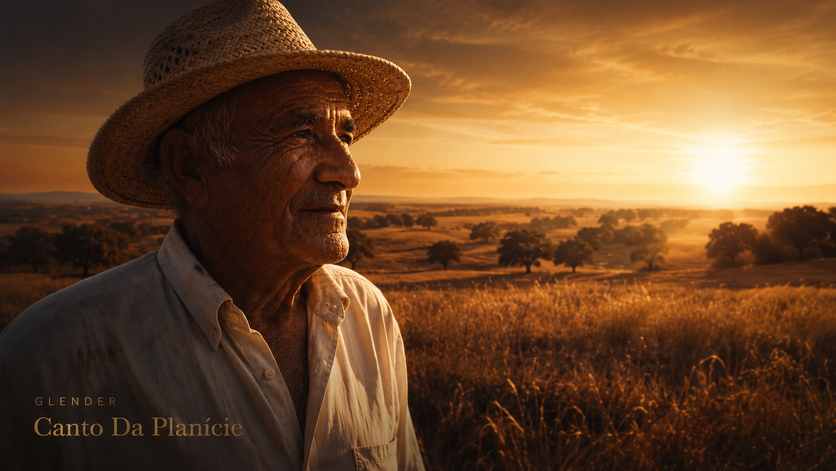
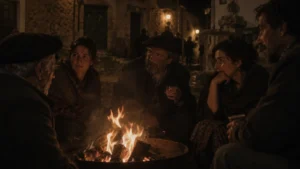
The film moves through the visual language of the Alentejo: the elderly man beneath the straw hat, the sun falling over the plain, olives on the branches, birds crossing the horizon, the stillness of the cork oak, and the community gathered around the fire at night.
The elder became the human face of the song.
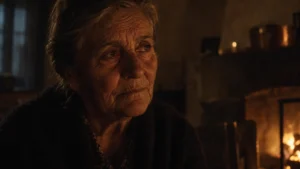
His expression carries more than one individual story. It represents time, labour, loss, knowledge, and the dignity of a generation that learned to communicate without needing many words.
His face is a landscape.
Every line appears to hold a season. Every silence suggests something remembered.
The communal fire later changes the emotional temperature of the film. What begins as a solitary journey across the plain becomes a shared experience. The darkness arrives, but the people create their own light.
As with my previous visual work, Artificial Intelligence was used as a cinematic tool, not to erase reality, but to build a visual poem from memory, symbolism, and emotion.
The objective was not to create a documentary of one specific village. It was to create a place that feels familiar to anyone who carries rural Portugal within them.
A village that may not exist on a map, but exists inside our collective memory.
A Transmontano Soul in the Alentejo
“Canto da Planície” is ultimately a song about recognition.
It is about discovering that belonging does not always depend on where we were born. Sometimes, another landscape reveals a part of us that was already there.
I remain a man of Trás-os-Montes.
The mountains, the xisto, the winters, and the voices of the North are part of everything I create. But the Alentejo showed me another expression of the same Portuguese soul.
In the North, strength rises like stone.
In the South, it stretches toward the horizon.
One resists the cold. The other endures the sun.
Both know the meaning of work. Both understand silence. Both carry music as a way of preserving what time tries to take away.
This song is my bridge between those two worlds.
Tradition Does Not Die. It Transforms.
I do not believe tradition survives by being protected behind glass.
It survives when we carry it forward.
It survives when an old rhythm enters a new production. When a regional voice reaches someone thousands of kilometres away. When a young listener hears a traditional feeling inside an electronic track and becomes curious about where that feeling came from.
“Canto da Planície” is not a recreation of the past.
It is a conversation with it.
It is my way of saying that the stories of our land still matter. The hands of our elders still matter. The voices in our villages still matter.
And they can still speak through new instruments, new images, and new generations.
The plain may appear silent.
But when we truly listen, it is full of voices.
With all my soul, Glender
The Alentejo is a living landscape shaped by the people who work it. For the region’s heritage, see the Alentejo and its distinctive plains.
Canto de Xisto → companion track on stone and ancestry
Douro → the journey continues from stone to horizon to water
Ancient Wisdom. Modern Spirit. → the Glender philosophy behind the music