Where the River Remembers: The Journey of “Douro”
Where the River Remembers: The Journey of “Douro”
Glender on ‘Douro’: an Afro House track shaped by the Douro river of northern Portugal, where stone, vineyard and memory move inside a contemporary electronic rhythm.
Key Takeaways – “Douro” is an Afro House track shaped by a river that already existed before us, and continues after us. – The song is about what remains when everything else moves on: memory carried inside movement, not nostalgia. – It sits alongside “Canto de Xisto” and “Canto da Planície” in a journey from stone, to horizon, to water. – The visual world follows the music: Portugal not as spectacle, but as emotional memory.
Some places are discovered.
Others are inherited.
They enter us long before we understand what they mean. They become part of the way we see distance, silence, work, beauty, loss, and belonging.
For me, the Douro is one of those places.
I come from the north of Portugal, from a territory where mountains shape the horizon, villages carry generations of memory, and the land has never been separated from the people who work it.
Here, stone is not decoration.
The vineyard is not scenery.
And the river is much more than water.
The Douro has watched people arrive and disappear. It has carried boats, harvests, voices, dreams, departures and returns. It has passed beneath the same slopes while generations changed above them.
That idea became the heart of “Douro.”
This song is not simply about one of Portugal’s most beautiful landscapes.
It is about what remains when everything else moves on.
The river continues.
And perhaps that is why we look at it and remember ourselves.
A River That Was Already There
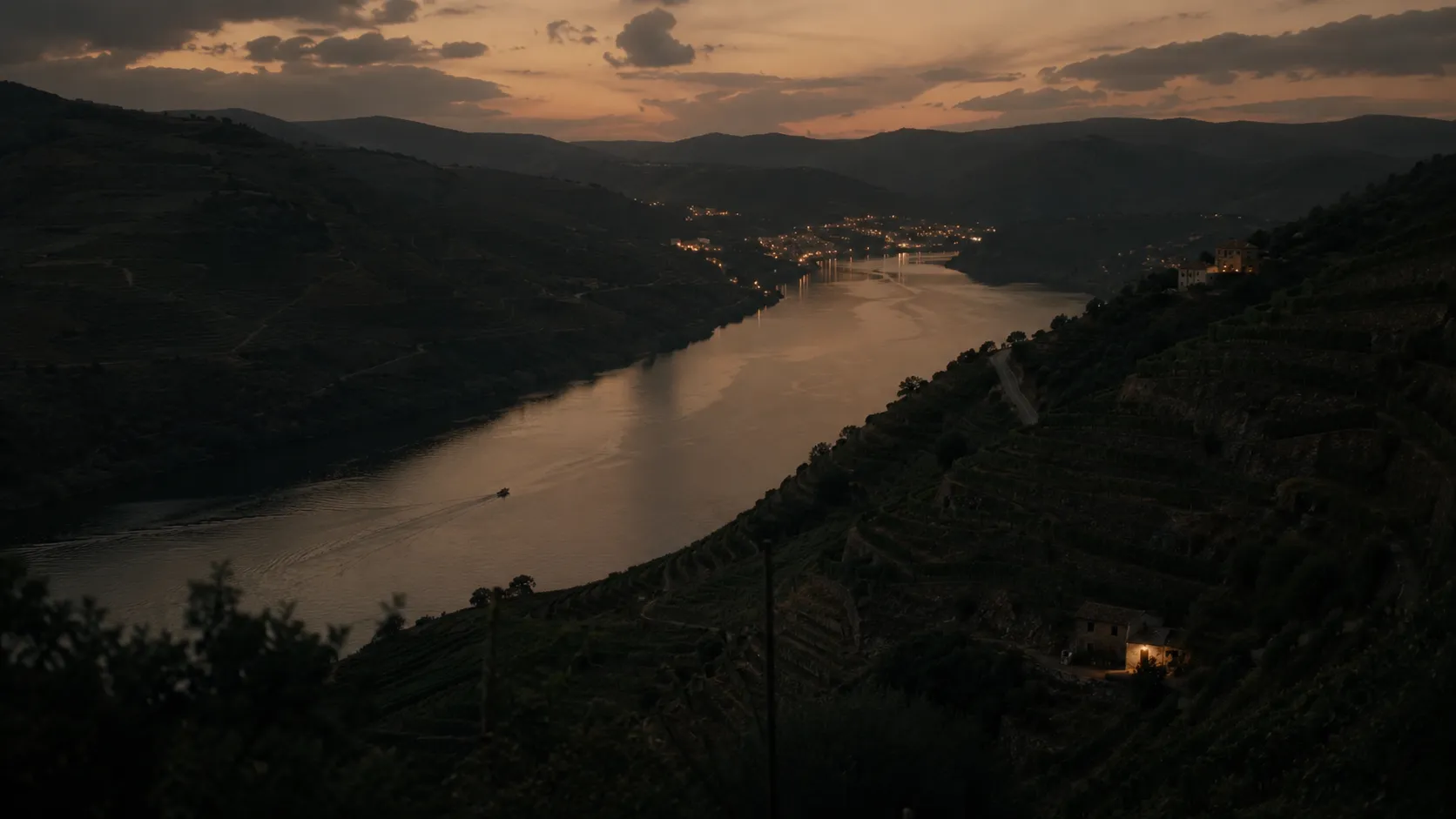
There is something humbling about standing above the Douro.
The vineyards descend through the slopes in lines carved by human hands. The xisto holds the heat of the day. Small villages appear between mountains. Roads twist through a geography that refuses to become simple.
And below all of it, the river moves.
Slowly.
Almost silently.
It was there before us.
It will continue after us.
When I began thinking about the emotional world of this track, that contrast became impossible to ignore: human life is temporary, but the landscape appears to remember.
We build.
We love.
We lose.
We leave.
We return.
And the river keeps moving through all of it.
That is why the opening image of the chorus became:
“Ó Douro, fio de prata no chão Caminho de rocha e de perdição Ó Douro, espelho de um triste luar Segues a vida sem nunca parar”
In English:
“Oh Douro, silver thread upon the ground A path of stone and wandering Oh Douro, mirror of a sorrowful moon You follow life and never stop”
The Douro is described as a silver thread because from the mountains it can appear almost impossible that something so narrow could hold so much history.
But it does.
The river connects places.
It connects generations.
And in this song, it also connects memory to movement.
From Stone to Horizon to Water
“Douro” belongs to the same emotional journey that has shaped much of my recent music.
With “Canto de Xisto,” I looked toward stone.
With “Canto da Planície,” I looked toward the endless horizon of the Alentejo.
With “Douro,” I wanted to look at movement.
Stone remains.
The plain waits.
The river moves.
These landscapes are different, but they are all ways of speaking about the same questions.
Where do we come from?
What do we carry with us?
What disappears?
And what refuses to disappear?
There is an ancient Portugal that does not exist only in museums, archives or old photographs.
It still exists in gestures.
In the way someone touches the soil.
In the silence of an elderly face.
In a wall built by hands whose names nobody remembers.
In a vineyard planted long before we were born.
In a river that has seen all of it.
My music has increasingly become a way of listening to those things.
Not trying to reproduce the past exactly.
Trying to hear what it might still be saying.
The Sound: Giving the River a Heartbeat
“Douro” moves at 121 BPM, within an Afro House language built around percussion, repetition and organic movement.
But the rhythm was never meant to fight against the landscape.
It had to become part of it.
When I thought about the Douro musically, I did not hear speed.
I heard continuity.
The current does not need to rush to be powerful.
It advances because it never stops.
That became an important principle in the production.
The percussion creates a physical pulse beneath the song, while the vocal and melodic elements carry something more human and fragile above it.
The electronic rhythm represents the present.
The words carry memory.
And between them exists the world I am constantly searching for as Glender: a place where something ancient can live inside something contemporary without losing its soul.
This is why I never see tradition and electronic music as opposites.
A drum can belong to the future and still awaken something ancient.
A voice can carry centuries of feeling through a modern sound system.
A Portuguese landscape can become a dance floor without becoming less Portuguese.
The purpose is not to place folklore over a beat.
It is to search for the emotional truth underneath both.
Xisto, Vineyards and Pain
One of the verses moves closer to the physical landscape:
“O vento desce o socalco devagar E o rio enrola-se em todo o olhar A vinha debruça-se em xisto e em dor O Douro é lume, é mágoa e fulgor”
The Douro is extraordinarily beautiful.
But beauty here was never effortless.
That distinction matters to me.
The terraces were shaped by work.
The vines survive on difficult slopes.
Stone walls hold mountains together.
Generations built lives in a geography that demanded something from them every day.
So when I write:
“A vinha debruça-se em xisto e em dor”
the word dor (pain) is deliberate.
I did not want to romanticize the landscape until the people disappeared from it.
Behind the postcard there are hands.
Behind the wine there is labour.
Behind the perfect sunset there are histories of sacrifice, migration, separation, poverty, endurance and return.
The Douro can be light.
But it also carries shadow.
That is why the next line contains three different ideas:
fire, sorrow and radiance.
“O Douro é lume, é mágoa e fulgor.”
Because a place can be beautiful and painful at the same time.
Perhaps the places we love most often are.
The Boat That Teaches Us What Does Not Return
There is one image in the song that, for me, contains much of its meaning:
“O batel risca a pele do cais E ensina à gente o que não volta mais”
The boat scratches the skin of the quay.
Then it leaves.
That small movement becomes a metaphor for time.
People leave marks on places.
Places leave marks on people.
But neither can stop the journey.
There is something deeply Portuguese in that tension between departure and belonging.
For generations, people have left the interior.
Some returned.
Some did not.
Families changed.
Villages became quieter.
Houses closed.
Names disappeared.
But memory continued to travel between those who stayed and those who left.
The river understands departure.
Water can never remain exactly where it was.
The Douro we look at today is physically not the same water we looked at yesterday.
And yet we continue to call it the Douro.
I find something beautiful in that contradiction.
Identity does not require stillness.
We can change and still remain connected to where we came from.
Perhaps we are all rivers in that sense.
Every Stone Is a Name
Later in the lyrics comes another idea that became essential to the song:
“Nas margens dorme o que ninguém viu Cada pedra é um nome que o tempo cobriu”
There are stories everywhere that were never written down.
That thought follows me constantly when I look at rural Portugal.
How many people walked these paths?
How many conversations happened beside these walls?
How many loves began here?
How many families waited for someone who had emigrated?
How many songs disappeared because nobody recorded them?
How many names survive only in the memory of someone who is now growing old?
History usually remembers important dates and important people.
But a landscape remembers differently.
A worn doorway remembers someone entering it thousands of times.
A field remembers repeated footsteps.
A stone wall contains the effort of the hands that lifted each rock.
A riverbank holds events nobody photographed.
That is the Portugal I am interested in.
Not only the Portugal written in books.
The Portugal stored inside places.
“Douro” is partly an attempt to give sound to that invisible archive.
The Visual World: Between Reality and Memory
The visual identity surrounding “Douro” had to follow the same principle as the music.
I did not want the region to become a tourism advertisement.
The Douro is already beautiful enough.
It does not need to be exaggerated.
What interested me was the emotional landscape beneath the visible one.
Xisto.
Vineyards.
Old houses.
Wind moving through the leaves.
Human faces.
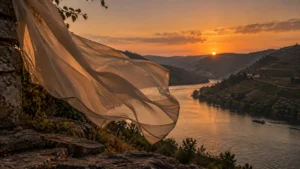
The river beneath fading light.
The last warmth of the day disappearing behind the mountains.
Everything grounded in a cinematic but recognizably Portuguese reality.
I wanted the imagery to feel as though we were remembering something rather than simply observing it.
Because memory is never perfectly sharp.
It arrives in fragments.
A face.
A hand.
A road.
A reflection on the river.
A piece of fabric moving in the wind.
Light entering an old room.
Someone standing where another person once stood.
The visual storytelling around “Douro” follows that logic: Portugal not as spectacle, but as emotional memory.
Technology can help construct those images, including Artificial Intelligence when it serves the idea, but the purpose remains human.
AI is a tool.
The memory, the intention and the story must come from somewhere deeper.
This Is Not Nostalgia
There is a danger when speaking about roots.
We can turn the past into something perfect that never truly existed.
That is not what I want to do.
I do not believe everything was better before.
It was not.
People struggled.
Opportunities were limited.
Many left because they had no choice.
Tradition can contain beauty, but it can also contain hardship.
For me, remembering is not the same as wanting to go backwards.
It means understanding what deserves to travel forward with us.
The dignity of work.
The relationship with the land.
The knowledge of our elders.
Community.
Patience.
The ability to sit in silence.
The understanding that we are part of something larger than our own individual lives.
These things still have value in a digital world.
Perhaps they have more value because of it.
“Douro” is therefore not a song asking us to return to the past.
It asks us not to reach the future empty-handed.
A Portuguese Story That Can Travel Beyond Portugal
There is another contradiction I have learned to appreciate through music.
The more specific a story becomes, the more universal it can sometimes feel.
“Douro” is unmistakably Portuguese.
It speaks of the river.
The terraces.
The xisto.
The vineyard.
The quay.
But you do not need to have been born beside the Douro to understand what it means to watch something change.
You do not need to speak Portuguese to understand the feeling of leaving home.
You do not need to know these mountains to have a place somewhere in the world that still lives inside you.
Every culture has its river.
Its mountain.
Its village.
Its road home.
Its names that time is slowly covering.
And perhaps that is where electronic music becomes such a powerful language.
A song can begin in a small place in Portugal and travel thousands of kilometres.
Someone dancing to it on another continent may never have seen the Douro.
But they can still feel longing.
Movement.
Loss.
Belonging.
The landscape is Portuguese.
The emotion is human.
Ancient Memory, Modern Movement
My relationship with electronic music has never been about escaping where I come from.
Increasingly, it has become a way of returning to it differently.
I spent many years learning how to make people move.
Now I am equally interested in understanding why something moves us.
Sometimes it is a rhythm.
Sometimes it is a voice.
Sometimes it is a memory we cannot fully explain.
“Douro” exists somewhere between those worlds.
Ancient memory.
Modern movement.
Organic emotion.
Electronic pulse.
The past is present, but it is not frozen.
It breathes.
It changes.
It travels.
Just like the river.
The River Does Not Forget
When I look at the Douro, I think about everything it has seen without ever being able to tell us.
Generations standing on its banks.
Boats disappearing around the bend.
Harvests carried downriver.
Children growing old.
People leaving.
People returning.
Houses filling and emptying.
Names appearing and fading.
The river has no voice.
So perhaps we lend it ours.
That is what this song became for me.
Not a portrait of the Douro.
A conversation with it.
A way of asking what a landscape remembers after we are gone.
And maybe the answer is already there in the chorus:
“Ó Douro, espelho de um triste luar Segues a vida sem nunca parar.”
Life does not stop.
Neither does the river.
But movement does not mean forgetting.
The Douro carries what came before while continuously becoming something new.
And perhaps that is also what I want my music to do.
To carry something forward.
A voice.
A landscape.
A feeling.
A fragment of Portugal.
Not preserved behind glass.
Alive.
Moving.
Changing.
Remembering.
The river continues.
And somewhere inside its current, so do we.
With all my soul, Glender
The Douro is a living landscape shaped by the people who work it. For the region’s cultural and natural significance, see the Alto Douro Wine Region (UNESCO World Heritage).
Canto de Xisto → companion track on stone and ancestry
Canto da Planície → companion track on the Alentejo horizon and return
Ancient Wisdom. Modern Spirit. → the Glender philosophy behind the music