Where the Fire Waits: The Journey of “Chama Antiga”
Glender on “Chama Antiga”: how a fire that never went out became a track built from cold ground, ash and fallen leaves, and where it sits in the journey from stone, to horizon, to water.
Some things are not chosen. They are recognized.
I have spent years following landscape through music. Stone, plain, river, the long memory of Portuguese ground. “Chama Antiga” arrives from a different room inside that same world. It does not begin with geography. It begins with weather.
Key Takeaways – “Chama Antiga” is an Afro House track about a fire that never went out: an old love or a memory that survives cold, distance and time. – The lyrics begin with absence, not warmth. The cold arrives first, and it is the cold that brings the name back. – The chorus is built as a call (“Fica, fica”), not a plea. Repetition is the ritual, and the vocables carry the pulse. – It completes a journey that moved through stone, horizon and water, and arrives at the only element that cannot be stored: fire. – The artwork keeps the flame deliberately small. One living ember in a bowl of ash is enough.
The Cold Comes First
Every fire in this song begins with absence.
The opening verse does not offer warmth. It offers weather.
“Veio o frio pelo chão Trouxe o teu nome até mim Folhas caem, o tempo passa Mas tu ficas dentro de mim”
In English:
“The cold came along the ground It brought your name to me Leaves fall, time passes But you stay inside me”
Read those four lines again and notice what they refuse to do. The cold does not take the name away. It carries it. “Trouxe o teu nome até mim”: the cold arrives as a messenger, not as a thief.
Leaves fall. Time passes. Every verb of loss is present, in order, exactly where you expect them. And then the sentence turns: “mas tu ficas dentro de mim.”
But you stay inside me.
In a song about fire, the first thing that happens is that something refuses to leave.
I grew up in a place where cold was not a mood. It was the ground you walked on from November to March, and fire was not decoration. It was how a house survived. You learn early that a flame is not admired from a distance. It is kept: fed slowly, protected from the wind, never left alone in a room you have stopped paying attention to. The opening lines of this song live in that same understanding. The cold comes first because it always comes first. What matters is what is still burning when it arrives.
A Fire Older Than Knowing
The second verse is the centre of the track.
“Já te amava antes de saber Já te ouvia antes de vir Há amores que o tempo leva E há os que voltam a existir”
In English:
“I already loved you before I knew I already heard you before I came There are loves that time takes away And there are those that come back to exist”
“I already loved you before I knew.”
That line describes recognition, not discovery. It says the feeling was there first, complete and unattached to any fact, and that understanding arrived later and simply caught up with it. Most love songs run the other way. They meet someone, and then they feel something. This one feels something, and then spends a lifetime finding out what it was.
Then the song draws its line: “há amores que o tempo leva / e há os que voltam a existir.” There are loves that time takes away. And there are loves that come back to exist.
That single distinction is the whole architecture of the track. It does not pretend that nothing is lost. It admits the first kind completely, without argument, because denial would make the second kind worthless. The promise at the end of the verse only means something because the loss at the beginning is real.
And the title lives in the second kind. “Chama antiga” does not describe a new fire. It describes one that was already burning before anyone arrived to watch it. Older than knowing. Older than the person who carries it. Waiting.
The Chorus Is a Call, Not a Plea
The chorus is six short lines and a name.
“Fica, fica Fica em mim Chama antiga Dentro de mim Fica em mim Chama por mim”
In English:
“Stay, stay Stay in me Ancient flame Inside me Stay in me Call for me”
The word doing all the work is “fica.” Stay.
It repeats immediately, without ornament, the way you repeat something when there is nothing else to say and repetition is the only thing left that still means anything. In Portuguese, “fica” is an ordinary word. It is what you say to someone at the door. It is what a parent says to a child at the end of the evening. It belongs to kitchens and hallways, not to poetry. That is exactly why it can carry a song.
I chose the imperative on purpose. This is not a plea. A plea asks a person to remain, and a plea already accepts that it might not work. An imperative does something more difficult. It holds the thing in place while it is being spoken. Every time the chorus returns, the fire is being kept.
Then the hook arrives, and language steps aside.
“Aya, aya, aya ê Tara, tara, tara ê Aya, aya Fica em mim Tara, tara Chama por mim”
These are not words to be translated. They are open vowels built for the body: a pulse, a breath, a shape the voice makes when meaning has already been carried far enough. In the arrangement they behave like percussion. The singer stops narrating and becomes a drum.
That is also the oldest instinct in this music. When language runs out, rhythm continues.
The Sound: Ash and Embers, Not Fireworks
In the studio the job was to hold two temperatures at the same time. Warmth and cold. Presence and absence.
The percussion carries the weight of the earth. It is a hearth, not a stadium. Nothing in the rhythm is trying to convince you of anything. It repeats, it settles, it makes a floor for the voice to stand on.
Over it, the melodic elements are treated like distance: sparse, open, unhurried. The sound of a horizon rather than a wall. When a melodic line appears, it does not fill the space around the voice. It stands at the far side of it and waits.
I did not build an explosion to release the tension, because the tension is not something to be released. It is something to be lived with. The chorus returning is the high point of the track, which means the reward is not adrenaline. The reward is recognition.
Silence does a real job here. The space between phrases is not empty. It is where a listener puts their own story, and it is the only part of the song I do not write.
What the Rhythm Had to Carry
A groove can announce itself, or it can accompany something. This one had to accompany a memory, which is a quiet thing to accompany. So the beat never overstates. It holds time the way a bowl holds embers: close to the ground, low, patient, letting the heat move slowly upward on its own. If you took the voice away, the rhythm would still be a room with a fire in it.
The Artwork: One Small Flame Is Enough

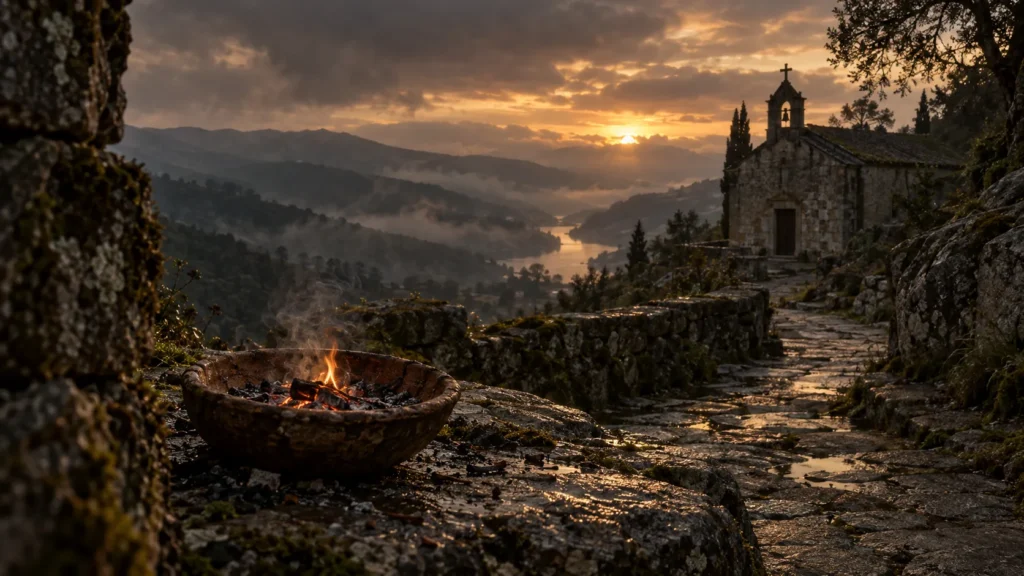
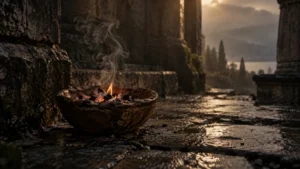
The cover is a single room and a single bowl.
A shallow vessel of fired clay sits on a cold stone floor. Inside it, ash: black, worked, exhausted. And in the middle of that ash, one living flame, small enough to cup with two hands, with a thread of smoke rising from it. Dry leaves have fallen across the stone. A narrow window lets one shaft of amber light into the dark.
The image and the first verse are the same sentence. “Veio o frio pelo chão” is that cold floor. “Folhas caem” is every leaf lying on it. The song and the artwork were not made separately. They were made from the same memory, and neither one explains the other.
But the decision that matters most is the size of the flame.
A bonfire is a performance. It is built to be seen from a distance, and it burns out quickly because it gives everything away at once. An ember is a relationship. It survives precisely because it is small and protected, and because someone, somewhere, kept it fed without needing an audience for it.
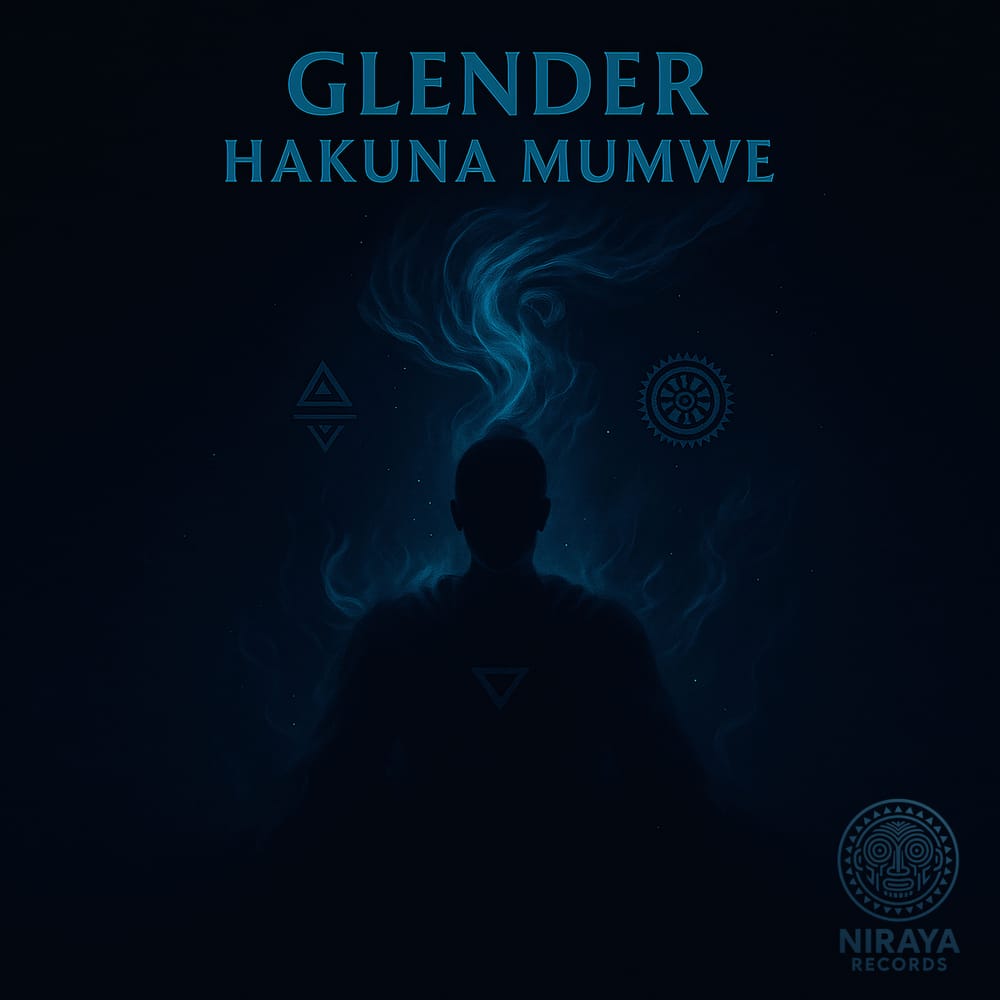
The cover carries the mark of ASMAR Records, the darker and more ritual-facing side of this world. Glender remains the artist. ASMAR is the house this chapter was built in.
The Element It Was Missing
This track did not arrive alone. It completes an arc.
- “Canto de Xisto” was stone: the north, the cold, ancestry, the strength of what does not bend.
- “Canto da Planície” was horizon: the south, the heat, time resting across the plain, the idea of return.
- “Douro” was water: the thing that was there before us and continues after us.
- “Chama Antiga” is fire: the thing that stays inside us.
Stone. Horizon. Water. Fire. Each of these songs was asking the same question from a different landscape, and this is the landscape I had not yet written. Not the ground beneath us. Not the sky above us. The small warmth we carry.
Fire had already appeared in this world once, in its coldest form. The Fire Within the Ice: The Story Behind “Tição de Inverno” is an ember kept alive through winter. “Chama Antiga” is the other half of that story: what is still burning after the cold has passed.
Why Fire Comes Last
Fire is the only one of these that cannot be stored as itself.
Stone can be built with. Water can be held in a vessel. A horizon can be looked at for the rest of your life and will still be there when you look again. But fire has no container that keeps it. It must be carried, fed and handed on, or it goes out.
That is why it belongs at the end of a journey about memory. Memory is exactly this kind of thing. Not an archive that sits still and waits to be consulted, but a flame that lives only as long as someone keeps moving it forward.
Ancient Wisdom, Modern Spirit
This is where a phrase I have used for years stops being a slogan and becomes a method.
Ancient wisdom is not a museum. A flame kept behind glass goes out. Fire needs air, fuel and attention, and the same is true of everything else worth inheriting. It stays alive only while it is being used.
So the production question was never “how do we make this sound old?” It was “how do we make it breathe now?”
An old feeling inside a modern low end. A voice from a village square moving through a system built for a dance floor. Percussion that could belong to a hundred years ago and drums that belong to this decade, sharing the same bar without one apologising to the other.
Tradition does not survive by being protected. It survives by being carried. Fire taught us that long before anyone thought to write it down.
What Stays
Every song leaves one question behind. This one leaves a simple one.
What has stayed with you longer than the reasons you once had for holding it?
Most of the things we lose, we lose because we stopped feeding them. We get busy. We get cold. We put the bowl down and walk away from the room, and time does the rest. And still, some fires refuse to go out on their own. They wait in the ash. Under the black, patient, exactly where we left them.
“Fica, fica Fica em mim”
Stay. Stay.
The cold will come again. It always does, and it always arrives the same way: along the ground, with a name in its hands.
This time it will find the fire already waiting.
With all my soul, Glender
Fire is the only element that cannot be stored, only carried. For the human relationship with fire and the hearth across cultures, see the entry on fire and the hearth.
Douro → the previous chapter, on water and what continues after us Canto de Xisto → companion track on stone and ancestry Ancient Wisdom. Modern Spirit. → the Glender philosophy behind the music